I've been neglecting my blog, my twitter activity and many other things since the recession seems to be finally over in my segment of the market (as an extension of the "unexpected" boom in Middle Eastern building market) which means I have just enough spare time to see my kids every evening and to sleep.
However I have decided to use my lunch break to type up a quick but very important note about an event which I have been informed about by a group of very interesting people some time ago. Because of the vision of livable London these people share, they have come up with and idea of a platform for people to learn and express their ideas about how to improve the city and turning it from a transit zone into a place that people actually want to live in.
Thus an event has been set up for people who would like to see London change into a much more pleasant place. It's called Street Talks and the first one of a series is going to be held in The Yorkshire Grey pub on Tuesday 8th March (2011). Anyone who'd like to share ideas, learn something about urban design or have a nice pint with interesting people is very welcome.
As mentioned by Mark at his ibikelondon blog:
Tom Barry, all-seeing Mayoral eye and editor of Boriswatch is the first speaker; Tom not only “reads through TfL Board minutes so you don’t have to,” he lives under the flight path at Heathrow and is first to guess when the Piccadilly line might break down and why.. he's kicking things off with a transport-focussed address; "State of the City - the highs and lows of London transport policy 2000 - 2011".
These events are a unique opportunity for people who would like to influence policies in London to unite, find out about what they can do and get support for their own initiatives.
See you there.
Oh, do check out their facebook page.
Thursday, 3 March 2011

Wednesday, 12 January 2011
cycling revolution - reality check
Firstly apologies for long pause in posting. As you all now I was out riding all day on my new bike. When I wasn’t riding my bicycle I was devouring massive amounts of posts my fellow bicycle bloggers were producing. Some of them where really amazing, some were annoying, because they were about the stuff I wanted to write about. Which is good, because it seems we share similar views.
The charming weather outside is taking it’s toll on me, this and the deepening depression caused by reading freewheelers rants made me reflect on the present and the future of mass cycling in London and UK. Let me just say that it’s overall even more depressing, however if it’s my feeling low influencing my views or my views influencing my depression I don’t know. Yet let’s not forget there is a light at the end of the tunnel, and that the spring and summer for cycling are yet to come.
 WARNING – this is a long post
There have been few things bothering me about the stance of the government regarding the situation on the road. Hardly anyone misses the fact that if you are not in a car you are usually 2nd or even 3rd category citizen at best. This is the result of waging the “war on motorists” apparently started by the Labour and now made to end my Tories. Many bloggers have been writing about the utter nonsense of calling it a war on motorists and that such thing never existed. If there were any nuisances created for the drivers they were
_ well compensated for by the comfort and privileges they get
_ a simple compensation for the damage the extremely high car usage has brought to the city
Now these changes are to be reversed. Which will create more congestion, more frustration, worse air pollution, and will generally decrease the quality of living in London and everywhere else to be frank.
Plus it’s a general misunderstanding to call people who use a car for transport motorists, just as calling people who use bicycles cyclists. It creates divisions and that’s really what it is about. This is not the way forward. We are all people, sharing the same space and choosing different modes of transport. What we need is a better awareness of how our choice affects ourselves and everyone else and infrastructure that values all choices in the same way. At the moment if you choose the car you are massively better off – however the cost to the society and most importantly for yourself is quite high.
The car is a very useful machine (even though it creates a lot of problems at the same time) – it’s convenient, fast, safe (for it’s user) and highly practical. Yet what needs to be said is that it proves to be useless in dense urban areas for the simple reason that there’s never going to be enough room for everyone to have a car. Yet by discouraging other modes of transport (crowded and overpriced PT, poor quality cycle provisions, cluttered and narrow pavements) we encourage more people to drive. And they do – not because they are bad or they don’t care (even if some don’t) but because of convenience. 90% of the population don’t want to be heroes – they simply want to live their lives in comfort, which the car offers to them.
 What’s left unsaid is that once people who drive get out of their cars they have to use crappy pavements, cover long distances on foot – which is the effect of taking space away from people to give them to cars. It baffles me why people don’t oppose – but then it’s probably because it’s compensated by the comfort of the car and some people simply hardly get out of them.
Now to change this situation a different approach is needed. And it’s a revolutionary one. This approach means that the space is divided according to the needs of different users. By allowing and making different transport modes equal you create an alternative for people to choose from. Yet provisions for all need to be made of the same quality.
 Why is this important? Because while people don’t want to be heroes, some genuinely want to cycle. They know about the benefits, they are willing to do it and their situation permits them to. According to this post the demographics are shaped in such a way that the current levels of people cycling fall in a very tiny percentage of the population. These are the people who already cycle – be it the sporty type or the utility type. They share the will to do so – some regardless of the circumstances. Obviously there’s also a group that would never cycle, period. This accounts for about 33% of population of Portland and I believe it’s somewhat similar in London. Now between the 8% of population who already cycle and the 33% of people who wouldn’t no matter what there is around 60% that would provide they were feeling safe and convenient. Unless this requisite is met cycling will not go up from the 2-3%, which it is at, at the moment.

This is because we’ve hit the barrier – all the cycling campaigns have been focusing on getting this small percentage of people on bikes. It’s easy when someone really wants to cycle. All the provisions the cycle campaigns want are sufficient to keep these people happy (oh, they like to complain, sure but that doesn’t mean that the status quo isn’t to their liking). What’s more disturbing is that the cycling campaigns are made up of people who cycle, so in the end they campaign for people who already cycle. They campaign for provisions adequate for less then 9% of the population. How do I know that – because people vote with their bikes the modal share remains at 2-3%. What other proof do you need?
And people are not lazy either – a lot of people go to gyms after work to get exercise that the bike would give them. Yet the concern about their safety doesn’t allow them. It’s really hard to take risks when you are the sole breadwinner and you have kids. Trust me. Thus a new type of cycling campaign must be born. A group of people that caters for the 66% of population that requires something else than painted lanes, which cars ignore. A campaign that is not afraid of calling the emperor’s naked and doesn’t dismiss examples from successful countries in Europe and lobbies to create comprehensive and high quality provisions.
Unless this happens we will be stuck with organisations who want well for their members of course, but who refuse to see that they marginalise cycling in effect. Plus they propagate the tired old myths about good cycling infrastructure: “we live in an ancient city” as if Amsterdam or Copenhagen we all built in the 20th century, “cycle tracks are dangerous” as if roads were safer, “there’s no political will” – well no, since nor you nor anyone else is lobbying for them how can there be, “it would cost billions” – billions less then the car infrastructure, plus how much does it cost to take one lane away from motor vehicles and put a kerb there so it’s not flouted on every occasion.
The light I mentioned at the beginning is the Cycling Embassy of Great Britain established by Jim from Lo Fidelity Bicycle Club. It seems that out of frustration born from interaction with the cycling campaigns a new kind of lobby is born. I am keenly following the embassy and will personally get involved to help them out.
 The biggest challenge in front of any such attempt is getting through to the general public. Let’s face it most of people who read cycle blogs are people who ride bikes anyway. While they’re of course not to be neglected the target audience are people who don’t. This is not about safety in numbers anymore – it’s about political force. And it’s not about getting people on bikes straight away either – they won’t until the road space is given to them to ride their bikes not worried about people driving their cars carelessly. It’s about getting people to write to their representatives and demand safe bicycle infrastructure to create liveable city.
There is hope since more and more people start buying practical bikes. There are more and more people writing about what to buy. While you might thinks it’s not relevant to mass cycling I think otherwise. The choice of bicycle determines its uses. A sporty bike will appeal to a user at first but will demonstrate its limitations quite soon becoming a toy rather then a tool. On the other hand a practical utility bike will be used a lot, for different purposes, proving a great investment. It will also prove to others around you that a car is not a necessity. People buying practical bikes drag riding bikes out of the niche sport cycling and the campaigns have pushed it into. No nonsense, no lycra just utilitarian tool. This in turn makes more people want to ride bikes, which in turn benefits them all.
While it’s important to get people who don’t ride bikes on them it’s also important to get people who already ride to act. The fact that the only voice belongs to the old cycling campaigns means that the status quo will be maintained. And there’s a lot anyone of us can do. For example the LIP consultation in the City of London. Any of us can write to their MP and councillors. It’s time to change the PR problem of the bicycle by showing the authorities that normal people want to ride their bikes safely on well designed cycle tracks.
PS. I am trying to help the Embassy by creating a visual campaign aimed to highlight the benefits of using bicycle for transport – all ideas welcome.
I wish you all Happy New Year on your bicycle.
The charming weather outside is taking it’s toll on me, this and the deepening depression caused by reading freewheelers rants made me reflect on the present and the future of mass cycling in London and UK. Let me just say that it’s overall even more depressing, however if it’s my feeling low influencing my views or my views influencing my depression I don’t know. Yet let’s not forget there is a light at the end of the tunnel, and that the spring and summer for cycling are yet to come.
 WARNING – this is a long post
There have been few things bothering me about the stance of the government regarding the situation on the road. Hardly anyone misses the fact that if you are not in a car you are usually 2nd or even 3rd category citizen at best. This is the result of waging the “war on motorists” apparently started by the Labour and now made to end my Tories. Many bloggers have been writing about the utter nonsense of calling it a war on motorists and that such thing never existed. If there were any nuisances created for the drivers they were
_ well compensated for by the comfort and privileges they get
_ a simple compensation for the damage the extremely high car usage has brought to the city
Now these changes are to be reversed. Which will create more congestion, more frustration, worse air pollution, and will generally decrease the quality of living in London and everywhere else to be frank.
Plus it’s a general misunderstanding to call people who use a car for transport motorists, just as calling people who use bicycles cyclists. It creates divisions and that’s really what it is about. This is not the way forward. We are all people, sharing the same space and choosing different modes of transport. What we need is a better awareness of how our choice affects ourselves and everyone else and infrastructure that values all choices in the same way. At the moment if you choose the car you are massively better off – however the cost to the society and most importantly for yourself is quite high.
The car is a very useful machine (even though it creates a lot of problems at the same time) – it’s convenient, fast, safe (for it’s user) and highly practical. Yet what needs to be said is that it proves to be useless in dense urban areas for the simple reason that there’s never going to be enough room for everyone to have a car. Yet by discouraging other modes of transport (crowded and overpriced PT, poor quality cycle provisions, cluttered and narrow pavements) we encourage more people to drive. And they do – not because they are bad or they don’t care (even if some don’t) but because of convenience. 90% of the population don’t want to be heroes – they simply want to live their lives in comfort, which the car offers to them.
Now to change this situation a different approach is needed. And it’s a revolutionary one. This approach means that the space is divided according to the needs of different users. By allowing and making different transport modes equal you create an alternative for people to choose from. Yet provisions for all need to be made of the same quality.


This is because we’ve hit the barrier – all the cycling campaigns have been focusing on getting this small percentage of people on bikes. It’s easy when someone really wants to cycle. All the provisions the cycle campaigns want are sufficient to keep these people happy (oh, they like to complain, sure but that doesn’t mean that the status quo isn’t to their liking). What’s more disturbing is that the cycling campaigns are made up of people who cycle, so in the end they campaign for people who already cycle. They campaign for provisions adequate for less then 9% of the population. How do I know that – because people vote with their bikes the modal share remains at 2-3%. What other proof do you need?
And people are not lazy either – a lot of people go to gyms after work to get exercise that the bike would give them. Yet the concern about their safety doesn’t allow them. It’s really hard to take risks when you are the sole breadwinner and you have kids. Trust me. Thus a new type of cycling campaign must be born. A group of people that caters for the 66% of population that requires something else than painted lanes, which cars ignore. A campaign that is not afraid of calling the emperor’s naked and doesn’t dismiss examples from successful countries in Europe and lobbies to create comprehensive and high quality provisions.
Unless this happens we will be stuck with organisations who want well for their members of course, but who refuse to see that they marginalise cycling in effect. Plus they propagate the tired old myths about good cycling infrastructure: “we live in an ancient city” as if Amsterdam or Copenhagen we all built in the 20th century, “cycle tracks are dangerous” as if roads were safer, “there’s no political will” – well no, since nor you nor anyone else is lobbying for them how can there be, “it would cost billions” – billions less then the car infrastructure, plus how much does it cost to take one lane away from motor vehicles and put a kerb there so it’s not flouted on every occasion.
The light I mentioned at the beginning is the Cycling Embassy of Great Britain established by Jim from Lo Fidelity Bicycle Club. It seems that out of frustration born from interaction with the cycling campaigns a new kind of lobby is born. I am keenly following the embassy and will personally get involved to help them out.

There is hope since more and more people start buying practical bikes. There are more and more people writing about what to buy. While you might thinks it’s not relevant to mass cycling I think otherwise. The choice of bicycle determines its uses. A sporty bike will appeal to a user at first but will demonstrate its limitations quite soon becoming a toy rather then a tool. On the other hand a practical utility bike will be used a lot, for different purposes, proving a great investment. It will also prove to others around you that a car is not a necessity. People buying practical bikes drag riding bikes out of the niche sport cycling and the campaigns have pushed it into. No nonsense, no lycra just utilitarian tool. This in turn makes more people want to ride bikes, which in turn benefits them all.
While it’s important to get people who don’t ride bikes on them it’s also important to get people who already ride to act. The fact that the only voice belongs to the old cycling campaigns means that the status quo will be maintained. And there’s a lot anyone of us can do. For example the LIP consultation in the City of London. Any of us can write to their MP and councillors. It’s time to change the PR problem of the bicycle by showing the authorities that normal people want to ride their bikes safely on well designed cycle tracks.
PS. I am trying to help the Embassy by creating a visual campaign aimed to highlight the benefits of using bicycle for transport – all ideas welcome.
I wish you all Happy New Year on your bicycle.
Tuesday, 28 December 2010
bakfiets long delivered prologue
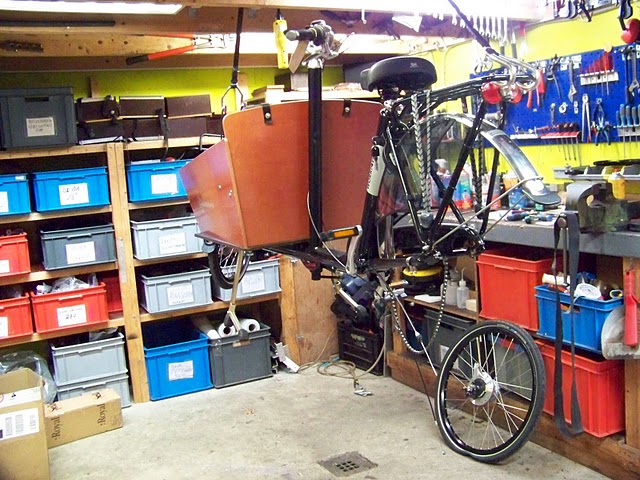
Richard from Workcycles has kindly provided me with some photographs of my bakfiets before it left their shop in Amsterdam. Enjoy.




Monday, 27 December 2010
Bakfiets Long delivered
In the morning, 23rd December a huge bloke with a peculiar accent knocked on my door. This could mean only one thing - the cargobike arrived from the Netherlands. The cheerful chap led me to his enormous lorrym where my precious purchase was waiting for me all wrapped in cardboard and tape with a distinctive Workcycles logo. I've been greening widely when I was freewheeling it back to my flat, and getting plenty of raised eyebrows on the way.Then finally I got it into my lobby


Thursday, 25 November 2010
Reply to my complaint about the "Brighten up" campaign
When I have first seen this game I thought it was in a very bad taste, not mentioning the ideas it carried.
I have written a complaint which follows:
"Dear Sir/Madame
I have written a complaint which follows:
"Dear Sir/Madame
I am writing to let you know that I am really amazed at the single sided
approach you have displayed by creating a game where children have
accident on a PEDESTRIAN CROSSING if not wearing enough hi-viz gear. I
always thought that it's the motorists who are to blame, and who should
slow down and pay more attention and not the children who get hit while
safely crossing the road. What you imply by this game is that we all
should be in a car or else we risk being injured. The game also implies
that people who drive a car have little or no responsibility for it -
oh, they haven't seen the kid - it must have been the lack of hi-viz. I
am really displeased with that.

Instead of making people who drive more aware, lower the speed limits,
put speed cameras, and what's most important enforce the law you focus
on children who don't have enough yellow reflective stuff on them.
Driving a car is a privilege not a right - people shouldn't be made to
think they should adjust their livestyles so that others can drive in a
carefree manner."
This is the reply I got:
"Apologies it has taken a while to get back to you on this. Our response to queries received on the Be Bright, Be Seen game is below. Please let me know if you have any other questions or if you would like further information on the research and evaluation findings used to develop and refine the campaign.Road Safety Minister Mike Penning said:
“This game is part of a range of educational materials designed to give children the skills they need to stay safe on the roads as they become more independent.
“By explaining the consequences of different behaviour, we are not attributing the blame for accidents to any particular road user. I am clear that everyone on the road has a role to play in creating a safe environment whether they are driving, riding, cycling or walking.”
To see all road safety campaigns from THINK!, including for car drivers (about speeding, seat belt wearing, drink & drug driving etc), motorcyclists, pedestrians and vulnerable / young road users, please visit http://www.dft.gov.uk/think/."
I still think that the responsibility for the safety of vulnerable road users should lay in the hands of people who drive, not the other way round. If it's dark and you are approaching a crossing - slow down to crawl if you need to - better that than to kill a person. Or maybe I am totally wrong.
It's cold!
Yes it now takes some time to warm up when riding my bike. Plus the low temperature or the wind made todays cycling super hard - it's either the hub or headwind. Hope it's the latter. Time to get the wooly hat out.
There have been a couple of hot topics lately in the world of bike bloggers. Especially important is the conviction of Dennis Putz - 7 years and lifelong ban for driving for killing Catriona Patel. Seems like LCC has finally grown a pair and is asking the right questions - why a driver with so many convictions was allowed on the road.
This also sparked a discussion over the ban of lorries in central London - a very difficult topic since while it would be superb to see them gone one must not forget about the services they provide - a good replacement or a different approach must be found.
Good news about opening the BorisBikes scheme to casual users. Everyone will be able to try out BBs and use them whenever they feel like it.
Then came Ray Sadri with his post suggesting handing out free helmets to casual boris bikers to which he received a lot of negative comments. He remains unaware of what fallacies he commits and what his ideas actually communicate to the public. Me and Mark from ibikelondon have left long comments trying to get the point across but they seem to have been misunderstood (or maybe there was no intention of comprehending). I've been cheeky enough to as people at Borisbikes.co.uk about their opinion about this idea.
Although Ray doesn't suggest compulsory helmets a short reminder what such law does to hire bike scheme.
There have been a couple of hot topics lately in the world of bike bloggers. Especially important is the conviction of Dennis Putz - 7 years and lifelong ban for driving for killing Catriona Patel. Seems like LCC has finally grown a pair and is asking the right questions - why a driver with so many convictions was allowed on the road.
This also sparked a discussion over the ban of lorries in central London - a very difficult topic since while it would be superb to see them gone one must not forget about the services they provide - a good replacement or a different approach must be found.
Good news about opening the BorisBikes scheme to casual users. Everyone will be able to try out BBs and use them whenever they feel like it.
Then came Ray Sadri with his post suggesting handing out free helmets to casual boris bikers to which he received a lot of negative comments. He remains unaware of what fallacies he commits and what his ideas actually communicate to the public. Me and Mark from ibikelondon have left long comments trying to get the point across but they seem to have been misunderstood (or maybe there was no intention of comprehending). I've been cheeky enough to as people at Borisbikes.co.uk about their opinion about this idea.
Although Ray doesn't suggest compulsory helmets a short reminder what such law does to hire bike scheme.
Friday, 19 November 2010
future projects
I am having a super stressful time at work right now, and it doesn't look like it's gonna change till the end of December. However there are things that come to my mind occasionally - little projects that I don't have time for yet, but which I would like to promise to my readers.
1) Segregated cycling infrastructure in London. Yes I know it's an oxymoron of sort, but trust me there are those little nuggets here - perhaps their design isn't ideal and they are disconnected but I would like to go and visit them, snap some photos and talk more about how they help or don't. I already have an extensive list, but if you have any ideas let me know in the comments.
2) Inspired by this article "A beginners guide to bike shopping" I want to go to different big and small bike shops and see what they are going to offer to someone who knows nothing about bikes (at least he pretends not to). This would be an indicator of how cyclists needs are perceived by salespeople and what choice do beginners get - are they thrown into spandex straight away and put on a carbon road bike or do sales people play safe and recommend hybrids first? Is the utilitarian cycling mentioned and taken into account at all? I would definitely need help with this as I am known in some of the shops already (no, I didn't start a brawl or anything).
1) Segregated cycling infrastructure in London. Yes I know it's an oxymoron of sort, but trust me there are those little nuggets here - perhaps their design isn't ideal and they are disconnected but I would like to go and visit them, snap some photos and talk more about how they help or don't. I already have an extensive list, but if you have any ideas let me know in the comments.
2) Inspired by this article "A beginners guide to bike shopping" I want to go to different big and small bike shops and see what they are going to offer to someone who knows nothing about bikes (at least he pretends not to). This would be an indicator of how cyclists needs are perceived by salespeople and what choice do beginners get - are they thrown into spandex straight away and put on a carbon road bike or do sales people play safe and recommend hybrids first? Is the utilitarian cycling mentioned and taken into account at all? I would definitely need help with this as I am known in some of the shops already (no, I didn't start a brawl or anything).
Subscribe to:
Posts (Atom)